Inspiration from the Human Brain
1. Why the Brain Matters to Deep Learning
Deep Learning did not appear out of nowhere — it was inspired by how the human brain processes information using billions of interconnected cells called neurons. Researchers wanted to build machines that could “think” or “learn” the way humans do, so they modeled artificial systems loosely on biological neural structure.
Core idea: If biological neurons can learn patterns, recognize faces, and understand language by passing signals between each other — maybe artificial neurons, connected in a similar way, can learn to do the same.
This gave birth to Artificial Neural Networks (ANNs) — the foundation of Deep Learning.
2. How a Biological Neuron Works
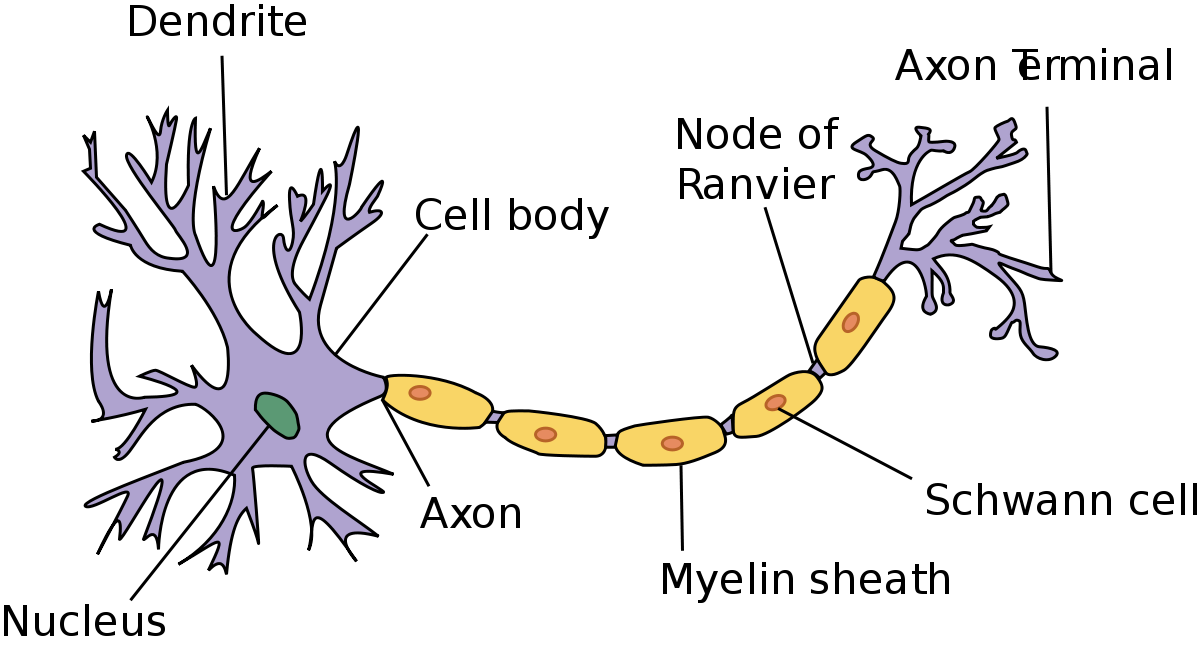
A neuron in the brain is a specialized cell that transmits information using electrical and chemical signals. It has four main parts:
| Part | Function |
|---|---|
| Dendrites | Receive signals (inputs) from other neurons |
| Cell Body (Soma) | Processes/combines the incoming signals |
| Axon | Carries the processed signal away from the cell |
| Synapse | The junction where signal passes to the next neuron |
Step-by-step working:
- Dendrites receive electrical impulses from neighboring neurons.
- The soma (cell body) collects and sums up all incoming signals.
- If the combined signal crosses a certain threshold, the neuron “fires” — it generates an electrical impulse (this is called an action potential).
- This impulse travels down the axon.
- At the synapse, the signal is passed to the next neuron (often chemically, via neurotransmitters), possibly strengthening or weakening depending on how often that connection is used.
- Repeated use of a connection makes it stronger — this is the basis of learning and memory in the brain (known as synaptic plasticity or, more famously, “neurons that fire together, wire together”).
3. Excitatory vs Inhibitory Signals — The Brain’s “Volume Control”
Not every signal reaching a neuron pushes it toward firing. The brain has two types of signals arriving at the synapse:
- Excitatory signals → amplify the incoming message, pushing the neuron closer to its firing threshold (more likely to fire).
- Inhibitory signals → dampen the incoming message, pushing the neuron away from its firing threshold (less likely to fire, or suppresses it entirely).
A single neuron doesn’t just “add up” everything blindly — it receives thousands of these excitatory and inhibitory inputs from other neurons simultaneously, and only fires if the net balance crosses the threshold. This balancing act is what allows the brain to:
- Filter out noise (irrelevant or weak signals get suppressed)
- Sharpen focus (important signals get amplified while competing ones are inhibited — e.g., how you focus on one voice in a noisy room)
- Prevent runaway/overactive firing (inhibition keeps neural circuits stable, stopping signals from spiraling out of control)
This is a key part of how the brain processes information intelligently, not just electrically.
Correlation with Deep Learning
This excitatory/inhibitory mechanism maps directly onto signed weights in an artificial neuron:
| Brain Mechanism | Deep Learning Equivalent |
|---|---|
| Excitatory signal (amplifies) | Positive weight — increases the weighted sum, pushing the neuron toward activation |
| Inhibitory signal (dampens) | Negative weight — decreases the weighted sum, pushing the neuron away from activation |
| Net balance of excitation/inhibition decides firing | Net weighted sum (Σ wᵢxᵢ + bias) decides the activation function’s output |
| Inhibition prevents overactive/noisy firing | Techniques like dropout, batch normalization, and regularization dampen certain activations to prevent overfitting or unstable (exploding) signals |
| Sharpening focus by suppressing weak signals | Attention mechanisms — amplify important input features while suppressing irrelevant ones |
Easy way to remember: In the brain, some connections say “yes, fire more!” (excitatory) and others say “no, calm down” (inhibitory). In deep learning, this is imitated by simply allowing weights to be positive (push up) or negative (pull down) — the network is not just “adding everything,” it’s constantly balancing amplification and suppression, just like real neurons.
4. The Artificial Neuron (Perceptron) — The Machine’s Version
Scientists translated this biological process into a mathematical model. This is called an artificial neuron or perceptron.
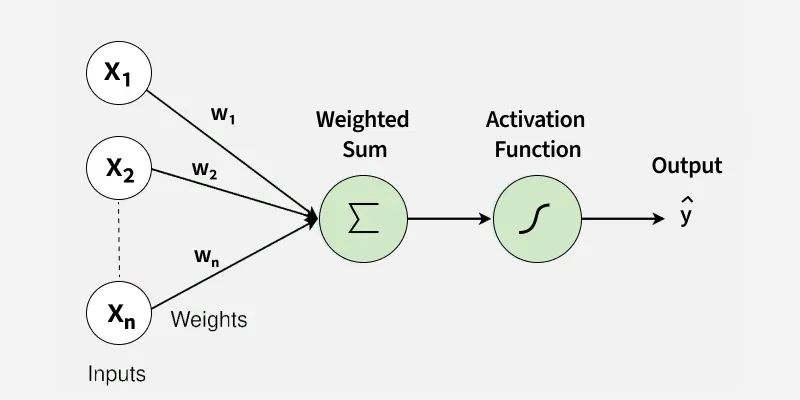
| Biological Neuron | Artificial Neuron (Equivalent) |
|---|---|
| Dendrites (receive signals) | Inputs (x₁, x₂, x₃…) |
| Strength of synapse | Weights (w₁, w₂, w₃…) |
| Cell body sums signals | Summation function (Σ wᵢxᵢ) |
| Firing threshold | Activation function |
| Axon (sends output) | Output (y) |
| Learning by strengthening synapses | Weight adjustment during training (backpropagation) |
How it works mathematically:
Inputs:        x1, x2, x3 ...
Weights:       w1, w2, w3 ...

Step 1: Weighted Sum
   z = (x1*w1) + (x2*w2) + (x3*w3) + bias

Step 2: Activation Function
output = f(z) → decides whether neuron "fires" (like brain threshold)- Bias is like a natural tendency of a neuron to fire — even with no strong input.
- Activation function (like Sigmoid, ReLU, Tanh) mimics the “firing threshold” of a biological neuron — it decides whether/how strongly the signal passes forward.
5. Side-by-Side Correlation (Quick Recall Table)
| Concept | Brain | Deep Learning |
|---|---|---|
| Basic Unit | Neuron | Artificial Neuron (Node) |
| Connection | Synapse | Weight |
| Signal strength control | Strengthening/weakening synapse | Adjusting weight values |
| Decision to activate | Threshold / action potential | Activation function |
| Network of units | Billions of neurons connected in layers (brain regions) | Neurons arranged in layers (Input → Hidden → Output) |
| Learning | Practice strengthens synaptic connections | Training adjusts weights via backpropagation |
| Memory | Stored in strengthened neural pathways | Stored in learned weight values |
| Massive parallel processing | Brain processes many signals simultaneously | Neural network processes data in parallel (matrix operations) |
| Signal amplification/dampening | Excitatory (amplify) vs Inhibitory (dampen) signals at synapse | Positive vs negative weight values |
6. From One Neuron to a Network
Just like the brain doesn’t rely on a single neuron but on networks of neurons organized in layers/regions (e.g., visual cortex for sight, auditory cortex for sound), Deep Learning uses layers of artificial neurons:
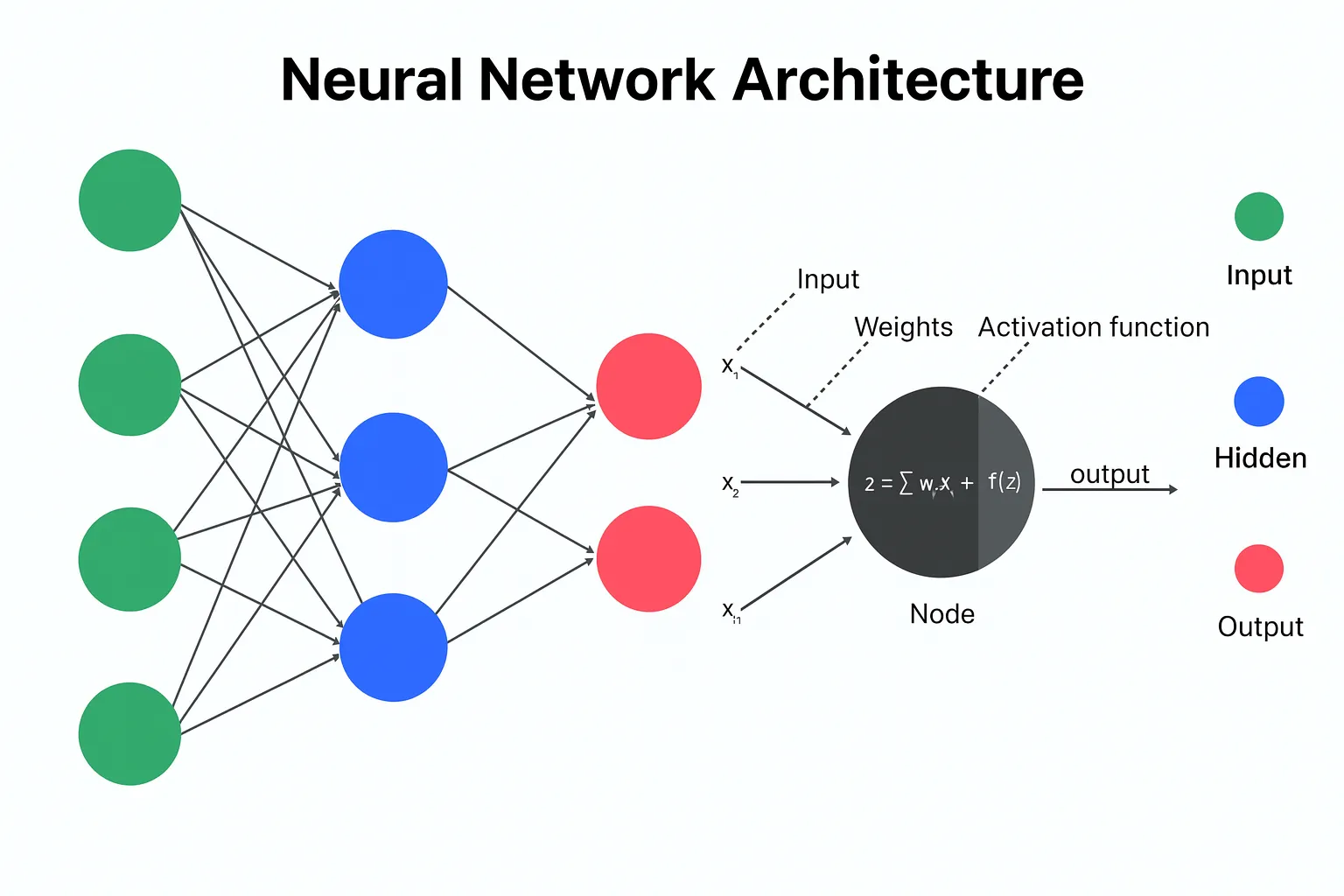
- Input Layer → receives raw data (like sensory organs receiving stimuli)
- Hidden Layers → process and extract patterns (like brain regions processing information step-by-step, e.g., edges → shapes → objects in vision)
- Output Layer → gives the final decision/result (like the brain producing a response or action)
This layered structure is why it’s called “Deep” Learning — “deep” refers to having many hidden layers, just as the brain has many interconnected processing stages before a final perception or decision is formed.
7. Learning Process Correlation
| Brain Learning | Deep Learning Equivalent |
|---|---|
| You touch fire → pain signal → brain learns “fire = danger” → next time you avoid it | Network makes a wrong prediction → error/loss is calculated → weights are updated → next time prediction improves |
| Repetition strengthens the correct pathway | Multiple training epochs strengthen the correct weight patterns |
| Forgetting/weakening unused connections | Regularization techniques (like dropout) prevent overfitting, similar to pruning unused synapses |
8. Key Takeaway (Easy Summary)
Think of the brain as the original inspiration, and deep learning as a simplified mathematical imitation of it.
- Brain neuron receives, processes, and fires signals → Artificial neuron receives inputs, computes weighted sum, and applies activation.
- Brain learns by strengthening synapses → Network learns by adjusting weights.
- Brain uses layered regions for complex processing → Deep learning uses layered networks (deep architecture) for the same reason: to break down complex problems into simpler stages.
In short: Deep Learning tries to mimic — in a simplified, mathematical way — how billions of neurons in our brain connect, communicate, and learn from experience.
Fun Fact
- Human Brain contains ~86 billion neurons (the widely cited figure, from neuroscientist Suzana Herculano-Houzel’s research)
- Each neuron connects to thousands of others via synapses — total synaptic connections are estimated at 100 trillion to 1 quadrillion